
Maverick County Sex Offender Checks
The Texas Public Sex Offender Registry is the main public channel for Maverick County. Texas DPS operates the statewide system without an account or search fee. A reader may search by a surname or initial, add a first name, or narrow the results with an address, city, ZIP code, or Maverick County filter. Map and list views offer two ways to read the same public data. Because the live interface can change with JavaScript updates, use the labels shown at search time rather than assuming a fixed radius choice.
A Maverick County lookup is only one layer. The profile identifies the registrar responsible for the entry, which matters when an address or status appears stale. Eagle Pass residents register with the city police department. People in unincorporated Maverick County register through the Sheriff. The Maverick County government directory and the Sheriff's official county page provide local agency routes when a state search needs follow-up. The registry is not a general criminal-case database, and a listing is not evidence of a new offense.
Maverick County Registration Offices
The correct Maverick County registrar depends on where the person lives. Within Eagle Pass, the Eagle Pass Police Department receives registration updates. In the county's unincorporated areas, the Maverick County Sheriff performs that role. This split is easy to miss because DPS presents the records in one statewide search. Read the registrar field before asking an office to check or correct an entry.
Eagle Pass Police Department
489 S. Monroe St., Suite A
Eagle Pass, TX 78852
830-773-9044
Monday through Friday, 8 a.m. to 5 p.m.
Maverick County Sheriff
1051 Balboa-Jones Memorial Blvd.
Eagle Pass, TX 78852
830-773-2321
Call before visiting for registry business.
Use the office connected to the listed residence, not whichever building is closest. Registration questions differ from requests for an arrest report, jail booking sheet, or court judgment.
Texas Public Sex Offender Registry Searches
Begin with the state portal and use the least broad search that fits the facts you know. A county filter can surface Maverick County entries, while a name search helps when the person's address is unknown. The official Texas registry search screen shows the controls readers use before opening a public profile.
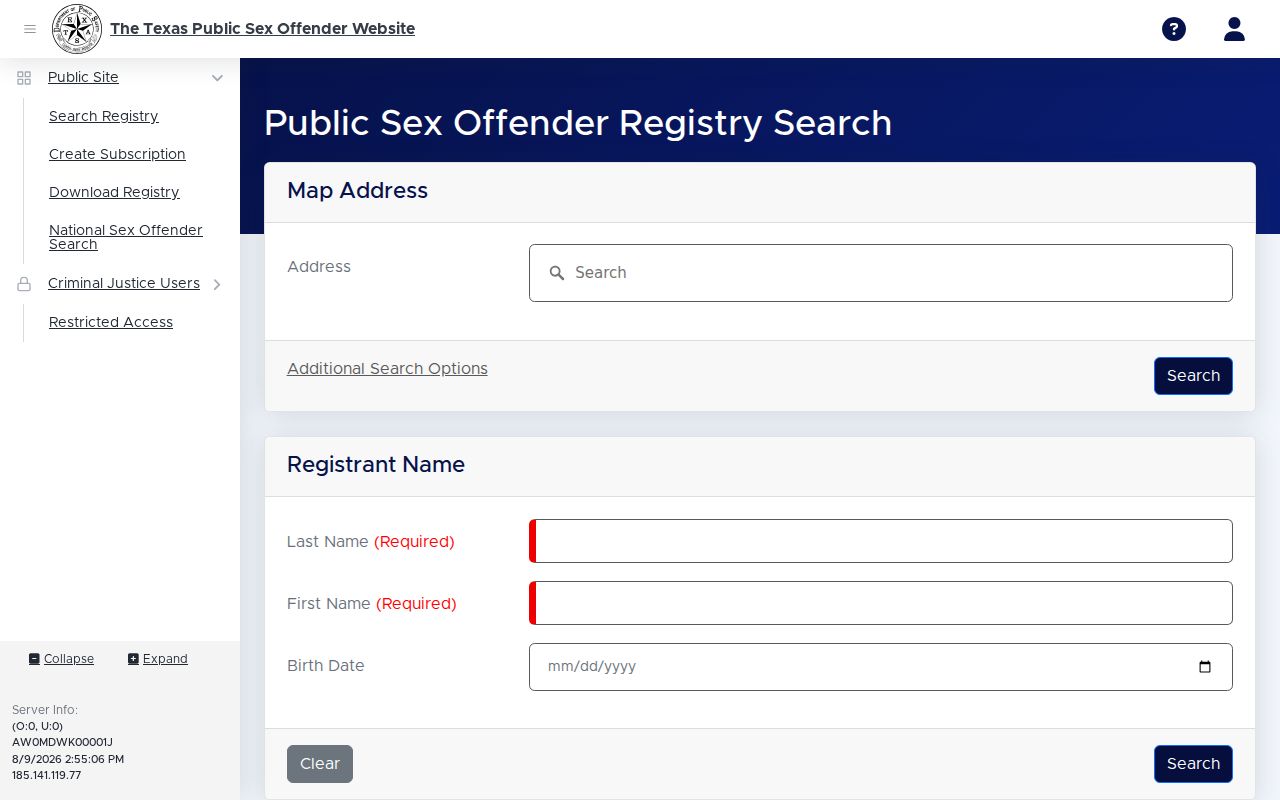
The interface makes it possible to move from a broad Maverick County result set to a profile, but identity still requires more than a similar name.
- Open the DPS registry and review its terms before searching.
- Enter a surname or choose location fields such as Eagle Pass, ZIP code, or Maverick County.
- Compare the result list with known physical and location details. Do not rely on a name alone.
- Open the profile and read its registrar, status, offense, address, and verification fields together.
| Field Label | Type | Required | Use |
|---|---|---|---|
| Surname or initial | Text | For name search | Starts a person search |
| First name | Text | No | Narrows a surname result |
| Address, city, or ZIP | Text | No | Limits results by place |
| County | Select | No | Choose Maverick for county results |
| Status | Select, when shown | No | Refines the result set |
| Map or list | View control | No | Changes how matching entries appear |
Maverick County Registry Map Views
List view is often best when a reader knows a name. Map view can support neighborhood awareness when the location is the main question. Neither mode changes the underlying Maverick County registry data, and neither guarantees that a pin represents the person's present spot at that moment. The public address and status fields should be read with the verification and registrar fields.
A map can also create false confidence near a boundary. Eagle Pass and unincorporated Maverick County use different registrars, yet both appear in the state system. Search the street address, city, ZIP, and county in more than one combination when the first attempt finds nothing. DPS's exact radius controls were not stable enough to document during research, so no distance option should be treated as permanent. A missing pin is a reason to retry the search, not proof that no reportable registration exists.
Registry Profiles: What They Show
A public profile groups identity, location, registration, and offense facts. Those groups answer different questions. A photo and physical description help distinguish people with similar names. The registered address and status tell where the record places the person and how the entry is classified. Offense and sentence fields describe the qualifying case, not a current allegation.
| Name and aliases | Public identity names used to match the correct profile. |
|---|---|
| Photo and traits | Photo, age or birth information, sex, race, height, weight, eye color, and hair color may appear. |
| Address and registrar | Reported location plus the police or sheriff office responsible for registration. |
| Offense details | Offense name, statute, conviction or adjudication, victim-age category, and sentence may be listed. |
| Risk information | Texas risk level and other status labels, which are distinct from federal SORNA tiers. |
| Registration status | Verification or compliance information and relevant dates when made public. |
| Vehicle information | Qualifying vehicle data may be public when the law permits. |
DPS withholds Social Security and driver-license numbers, phone numbers, online identifiers, employer identity and contact data, victim identity, and confidential additions used by criminal-justice agencies. A Maverick County public profile is therefore useful but deliberately incomplete.
Maverick County Registry Fields Decoded
Risk, duration, and verification are related but not interchangeable. Texas risk levels describe assessed danger. They do not set a federal tier, and the number alone does not tell how long registration lasts. Duration turns on the qualifying offense and history under Texas law. Verification frequency can become more frequent for certain histories or civil commitment.
Address status also needs care. It reflects a reported registration fact, not a live tracking service. If a Maverick County listing looks old, note the registrar and contact that office or DPS rather than confronting anyone at the address. DPS Sex Offender Registration staff can receive nonemergency compliance information at 512-424-2800. Call 911 only for an emergency. That route gives trained officials the chance to check the record and the underlying duty.
For a look at the agency structure behind those fields, the DPS Crime Records Division gateway identifies the state unit that maintains criminal-history and registry services.

The statewide program receives local verification data, while Eagle Pass Police or the Sheriff remains the practical local contact shown by a Maverick County profile.
Registration Levels and Duties in Texas
Texas uses risk levels 1, 2, and 3, described as low, moderate, and high. These levels express assessed danger. They are not federal SORNA tiers, and they do not by themselves set the end date. Under Code of Criminal Procedure Chapter 62, offense category and history generally control whether the duty lasts for a defined post-release period or for life.
| Texas category | Duration | Verification pattern |
|---|---|---|
| Risk level 1, low | Offense and history based, commonly 10 years or life | Most registrants verify annually |
| Risk level 2, moderate | Offense and history based, commonly 10 years or life | Most registrants verify annually |
| Risk level 3, high | Offense and history based, commonly 10 years or life | Most registrants verify annually |
| Two or more sexually violent offenses | As Chapter 62 requires | Every 90 days |
| Civil commitment | As Chapter 62 requires | Every 30 days |
For many non-lifetime adult categories, the period is generally ten years after the latest discharge or release. Article 62.101 identifies lifetime categories. A profile's risk number should never be used as a shortcut for that offense-based analysis.
Maverick County Verification and Notice
Most Maverick County registrants verify once each year. A person with two or more sexually violent offenses generally verifies every 90 days, while a person under civil commitment verifies every 30 days. Local police or the Sheriff handles the check-in based on the registered residence. DPS then provides the public statewide layer.
Community notice follows separate rules. For a high-risk person or someone under civil commitment, postcard notice reaches a one-mile area in an unsubdivided setting or three blocks in a subdivided area. Those distances describe the notice area. They are not a statewide rule barring every registrant from living near a school or park. Texas Chapter 62 creates no universal school or park buffer. A supervision condition or a valid local ordinance may still impose a limit in a specific case.
Note: Verification schedules, risk levels, residence rules, and public notice serve different legal functions and should be checked one at a time.
Maverick County Registry and NSOPW
Maverick County sits at an international border and near state travel routes, so a Texas-only search may not answer every location question. The U.S. Department of Justice runs the National Sex Offender Public Website, or NSOPW, which sends a query across participating jurisdiction registries. It is a supplement to the Texas source, not a replacement for a Maverick County registrar.
The official NSOPW gateway shows the national search layer available when the relevant location may extend beyond Texas.
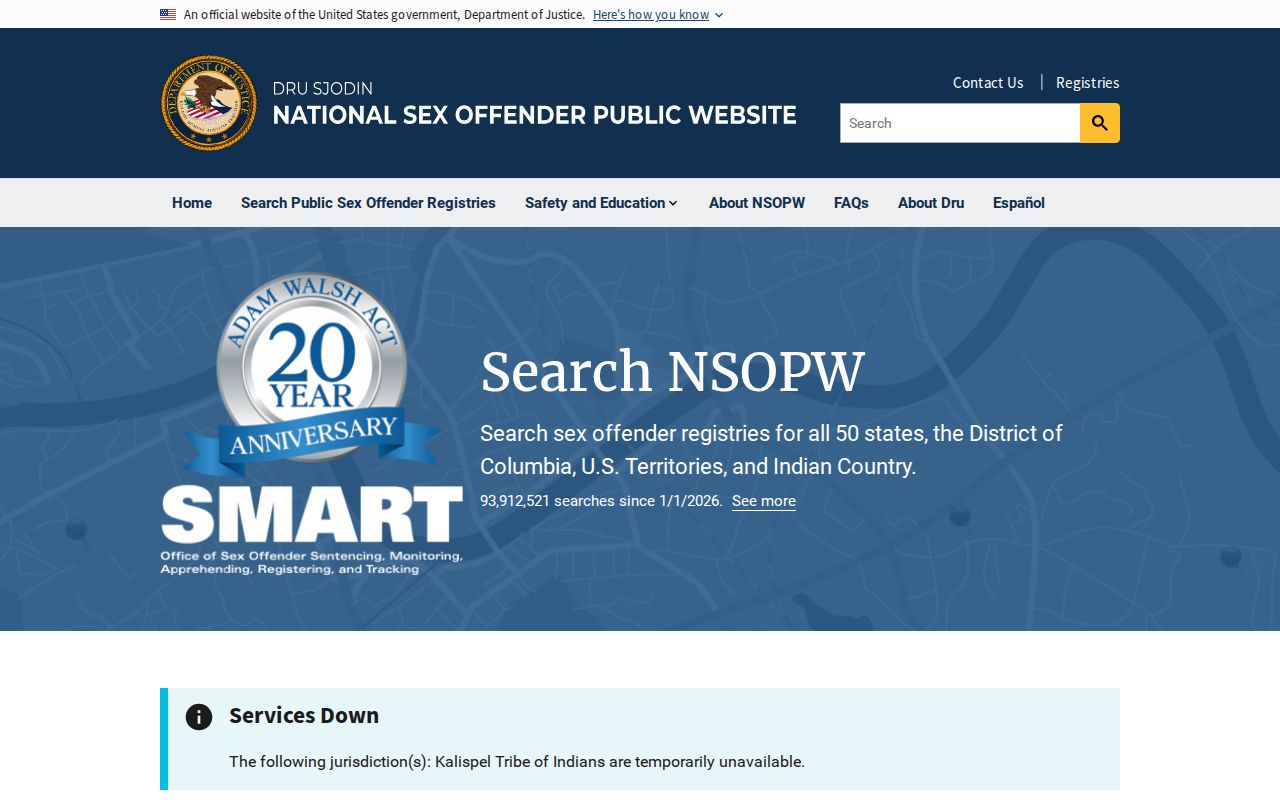
Return to the DPS profile for Texas registration detail and use the listed Eagle Pass or Maverick County office when a local status needs review.
Using Registry Information Lawfully
Registry data is published for awareness and safety planning. It can help a family understand a public listing, identify the responsible registrar, and decide when to contact law enforcement. It does not authorize a threat, harassment, trespass, vigilantism, or discrimination. It also does not establish that a listed person committed a new crime after the qualifying case.
Use the record with care: Texas Code of Criminal Procedure Chapter 62 governs registration and public information. It does not grant permission to harass, threaten, trespass, or confront a registrant, and such conduct may violate other Texas laws.
Report suspected noncompliance to the registrar listed on the profile or to DPS at 512-424-2800. For an urgent threat, call 911. Giving officials the profile name, address, status, and reason for concern is safer and more reliable than taking action against a Maverick County resident yourself.